

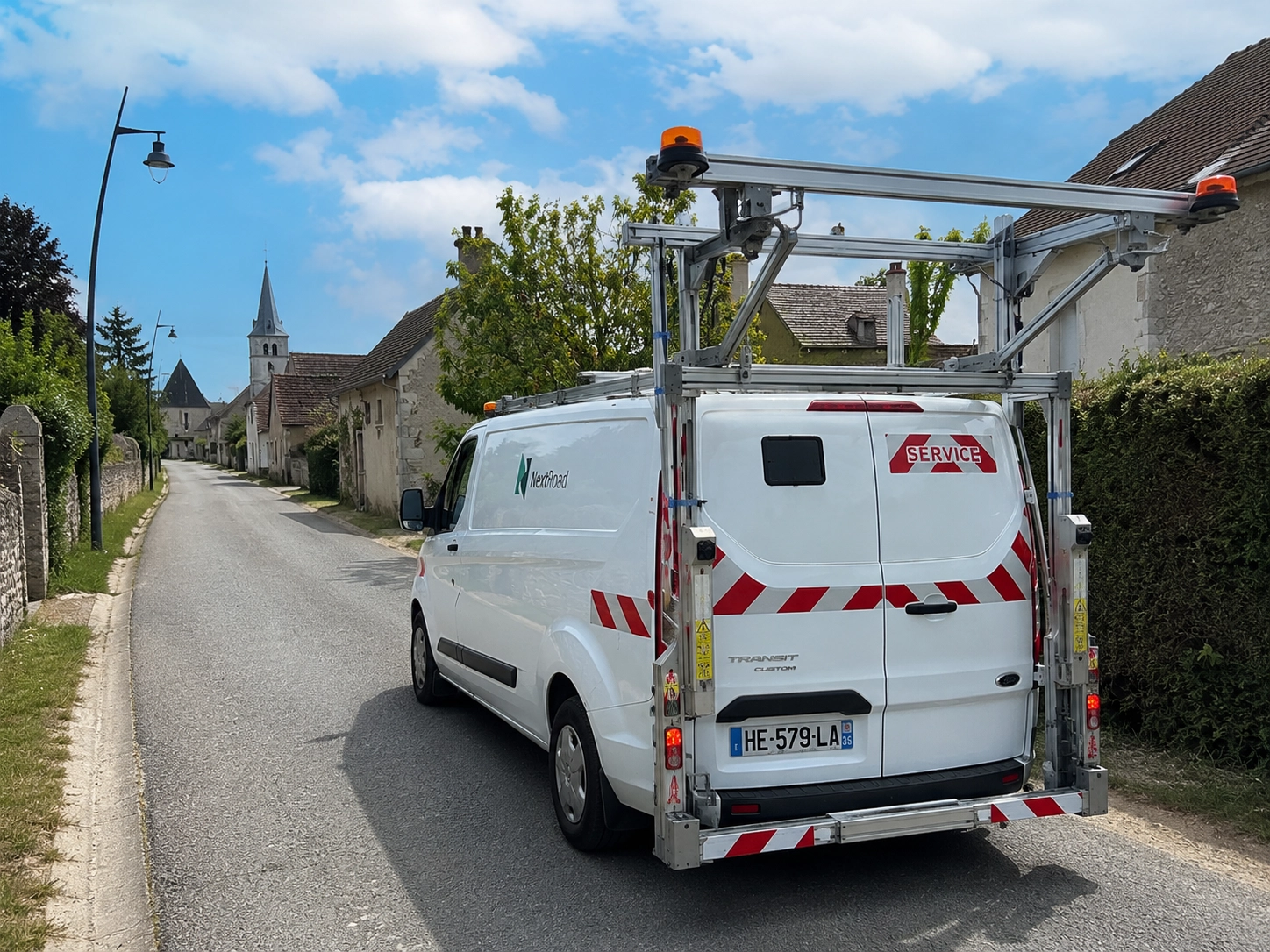
In France, a significant share of local road networks is ageing faster than the budgets allocated to their maintenance. For local authorities, the question is no longer whether action is needed, but where, when, and how to invest the resources available. In this context, having an accurate understanding of the condition of road assets is essential for guiding maintenance and investment decisions. This is precisely the purpose of a road infrastructure audit.
NextRoad supports local authorities in the assessment and management of their road infrastructure, helping decision-makers prioritize interventions, optimize budgets, and enhance road user safety.
What Is a Road Infrastructure Audit?
A road infrastructure audit consists of assessing the overall condition of a road network to identify existing defects and deterioration affecting the pavement and associated assets.
This process helps detect issues such as:
- Cracking,
- Potholes,
- Surface depressions and settlements,
- Drainage and water runoff problems,
- Road signage deficiencies,
- Areas that may pose safety risks to road users.
Inspections also make it possible to identify more technical pavement distresses, including alligator cracking, rutting, longitudinal and transverse cracking, raveling, aggregate loss, and surface disintegration.
The objective is straightforward: to obtain a reliable diagnosis that supports informed maintenance planning and investment decisions.
A road infrastructure audit also enables local authorities to prioritize interventions based on the actual condition of pavements. This approach helps align maintenance strategies with on-site needs while reducing the costs associated with emergency repairs and advanced deterioration.
To ensure an objective and reliable assessment, it is recommended to engage an independent road engineering specialist capable of providing a neutral evaluation of the road asset portfolio.
Today, methodologies developed from the research of the former Laboratoire Central des Ponts et Chaussées (LCPC), particularly Method 38.2, are widely recognized as industry benchmarks for delivering consistent, standardized, and cost-effective pavement diagnostics. Recommendations issued by the IDRRIM further highlight the value of these approaches in supporting local authorities with the sustainable management of their road infrastructure assets.
Why Conduct a Road Infrastructure Audit?
Better Prioritize Maintenance and Rehabilitation Works
Not all roads deteriorate at the same rate.
Without accurate condition data, local authorities often find themselves responding to problems as they arise, leading to higher costs and less efficient management of road assets.
A road infrastructure audit helps prioritize interventions based on:
- The level of pavement deterioration,
- Traffic volumes and road usage,
- Safety risks for road users,
- The future cost of repairs if maintenance is delayed.
This approach enables local authorities to focus available budgets on the sections of the network that require attention most urgently, ensuring that investments are directed where they will have the greatest impact.
Avoid Carrying Out Maintenance Too Early...or Too Late
Repairing a pavement at the right time is significantly less expensive than undertaking a full reconstruction just a few years later.
By gaining a comprehensive view of the road network, local authorities can implement a preventive maintenance strategy rather than relying on reactive repairs.
The benefits include:
- Fewer emergency interventions,
- Better control of maintenance and investment budgets,
- Extended service life of road infrastructure.
This proactive approach helps preserve asset value over the long term while reducing the overall cost of network ownership.
Improve Road User Safety
Deteriorated road infrastructure can lead to accidents, vehicle damage, and potential liability issues for local authorities.
Road infrastructure audits help identify high-risk areas at an early stage and reduce hazards associated with:
- The formation of potholes,
- Reduced skid resistance and loss of pavement grip,
- Visibility issues,
- Deficiencies in road signage and road markings.
The goal is to provide a safer and more reliable road network for all users, including motorists, cyclists, and pedestrians. By addressing safety concerns before they become critical, local authorities can improve network performance while reducing exposure to risk and liability.
Develop a Multi-Year Investment Plan
A road infrastructure audit is not limited to identifying existing defects and deterioration.
It also provides the information needed to anticipate future pavement performance and develop a Multi-Year Investment Plan (MIP) for the road network.
This forward-looking approach helps local authorities to:
- Spread expenditures more effectively over time,
- Plan maintenance and rehabilitation works in advance,
- Secure and justify future budget allocations,
- Communicate investment priorities more clearly to elected officials and residents.
By combining current condition assessments with long-term asset management objectives, a road infrastructure audit supports more predictable, sustainable, and cost-effective infrastructure planning.
New Technologies Supporting Road Infrastructure Audits
Road inspection methods have evolved considerably in recent years. Whereas pavement assessments once relied primarily on manual observations, local authorities can now leverage digital technologies that provide a more comprehensive and objective view of their road assets.
Today, inspections can be carried out using survey vehicles equipped with high-definition cameras, geolocation systems, and automated analysis tools. These technologies enable rapid identification of pavement defects across an entire road network while ensuring accurate traceability of observations.
The data collected offers several key benefits:
- Precise geolocation of defects and pavement distresses,
- Remote visualization of road conditions,
- Long-term archiving of inspection records,
- Comparison of pavement condition trends between survey campaigns,
- Centralization of data within a single asset management database,
- Easier production of maps, dashboards, and maintenance programs.
These technologies also make it possible to assess extensive road networks within shorter timeframes while maintaining consistency and standardization across all inspections.
However, technology alone is not enough. While digital tools can detect, measure, and document pavement defects, expert interpretation remains essential for understanding deterioration mechanisms and defining the most appropriate maintenance strategies.
At NextRoad, we combine advanced road survey technologies with pavement engineering expertise to transform field data into reliable diagnostics and practical recommendations that help local authorities make informed maintenance and investment decisions.
Why Work with Road Engineering Experts for a Road Infrastructure Audit?
Why Identifying Defects Alone Is Not Enough
Identifying pavement defects does not always lead to the correct diagnosis.
The purpose of a road infrastructure audit is not only to record visible deterioration, but also to understand the underlying causes of the observed defects in order to recommend maintenance solutions that are truly suited to the pavement’s condition and its likely future evolution.
Expert analysis makes it possible to distinguish between:
- A superficial crack and a deeper structural defect;
- An isolated issue and a widespread deterioration phenomenon;
- Damage caused by traffic loading and deterioration resulting from drainage deficiencies or structural weaknesses.
This field expertise provides significant added value when prioritizing maintenance works and defining long-term asset management strategies.
By combining inspection data with engineering analysis, road experts can determine not only what defects are present, but also why they have developed and how they are likely to evolve over time. This enables local authorities to select the most effective intervention at the right time and avoid inappropriate or unnecessarily costly repairs.
The following three examples illustrate how expert assessment can reveal issues that a non-specialist observer might easily overlook.
Case Study #1: The Pothole That Reveals a Drainage Problem
- A recurring pothole. A maintenance technician will see a pothole that needs to be repaired. An expert, however, will analyse the surrounding conditions: standing water along the edge of the pavement, the absence of a gutter or drainage channel, and clay soils that are prone to swelling during wet periods. The expert may conclude that the real cause is water infiltration into the pavement foundation layers and will recommend not simply patching the surface, but improving the drainage system combined with a more extensive repair of the affected area. Without this level of analysis, the local authority may end up repairing the pothole twice a year without ever solving the underlying problem.
Case Study #2: Edge Cracks Caused by a Structural Defect
Longitudinal cracks along the edge of the pavement. A non-expert may simply note the presence of cracks and consider applying a surface treatment. An expert, however, will identify, based on their location and progressive widening, that they are caused by edge movement resulting from an unstable shoulder or insufficient structural support at the pavement edge. The expert’s recommendation will be to stabilize the shoulder and strengthen the pavement edge rather than apply a surface treatment that is likely to fail within a few months. In this case, an accurate diagnosis helps avoid unnecessary expenditure and ensures that maintenance resources are allocated to the appropriate type of intervention.
Case Study #3: Rutting as a Sign of a Deeper Structural Failure
Rutting on a heavily trafficked road. At first glance, the pavement may simply appear worn. By combining rutting measurements with traffic data and information about the age of the pavement structure, an expert can determine whether the rutting is superficial (caused by surface ageing) or whether it indicates a structural weakness within the underlying pavement layers. In the first case, renewing the wearing course may be sufficient. In the second, only a partial reconstruction or structural strengthening of the pavement will prevent rapid deterioration after the works have been completed. The cost difference between these two scenarios, and, more importantly, between intervening at the right time and acting too late, can amount to tens of thousands of euros on a road section measuring only a few hundred metres.
An Expert Approach to Road Infrastructure Audits
At NextRoad, we believe that a road infrastructure audit should do more than simply generate inspection data. It should help local authorities gain a clearer understanding of the actual condition of their infrastructure and the mechanisms driving pavement deterioration.
Our approach combines road engineering expertise, field analysis, and modern survey technologies to deliver reliable diagnostics that are both practical and aligned with the operational needs of infrastructure managers.
The objective is to transform field observations into clear, consistent, and actionable recommendations, enabling local authorities to make informed maintenance and investment decisions with confidence.
Conclusion
A road infrastructure audit is not simply about identifying and recording pavement defects. It helps uncover the underlying mechanisms that cause deterioration, enabling local authorities to intervene in the right place, at the right time, and with the most appropriate level of maintenance or rehabilitation works. This ability to transform field observations into informed decisions is what makes a road audit a true road asset management tool.